
More than just pretty colors
On giving my work (and myself) more credit than I currently do.

If you’ve read my previous posts, you know I’ve been ruminating on how my artwork shows up in the world outside of the limits in which I present it. I’ve talked about my hesitancy to afford my artwork a voice of its own, often dumbing its meaning down by focusing on how “fun” it is as the selling point instead of talking about the artistic components of the work and the underlying inspiration.
I have felt a strange distance between my view of my self and the physical work that my hands create due to the difference in aesthetics. My work is bold and bright, my use of pink rampant. In every other aspect of my life, however, I’m drawn to earth tones and natural textures, abandoning busy colors in favor of curating a more muted and considered home space and wardrobe.
I am working on closing that distance, allowing what I see in the mirror to reflect back to me in my creative work. I was pondering this effort in the car the other day, and it came to me: my tendency toward a highly curated wardrobe and home interior is in fact reflective of a personality trait that shows up in my work: a love of order and being in control.


The intention-filled compositions of my paintings are a reflection of the level of organization and exactness I pursue in my life — a pursuit that is in direct competition with my raging ADHD, which strives to derail any attempts at imposing structure on my creative process.
I’ve tried creating abstract paintings, working on paper and raw canvas, brushing on swaths of color and adding marks with oil sticks and pastels. I have failed repeatedly, seemingly unable to reckon with the lack of structure involved in that process, overanalyzing each decision and eventually overworking the piece. I’m sure that, with practice, I could approach the spontaneity and fluid mark-making I admire in my abstract painter friends’ work with more confidence, but all attempts thus far have left me feeling confused and underwhelmed by the final result.
So instead I am meticulous, slowly and thoughtfully drawing out compositions and painstakingly pulling the lines, honoring my need for precision and good, clean illustration…. and then my ADHD kicks in and the colors pour out of me, a joyful delivery of pigment to complement the measured arrangement of motifs.
The first person to ever point out this marrying of order and playful expression my work was a collector in 2020, who purchased a cut paper piece I created for a group show (see below — hi Jim + Shelley!). Jim was drawn to this particular piece as an architect; the grid motif and methodology of the hand-cut paper medium appealed to him, while the wild floral elements were reflective of Shelley’s passion for gardening — a marriage of artistic elements reflective of the balance in their own partnership. Not only was it so special to see someone fall in love with my work on sight, it was incredibly eye-opening for me as the artist, realizing for the first time the connection between the rigid ideals I hold and desire for the freedom and chaos that comes in looser work I can only aspire to create.
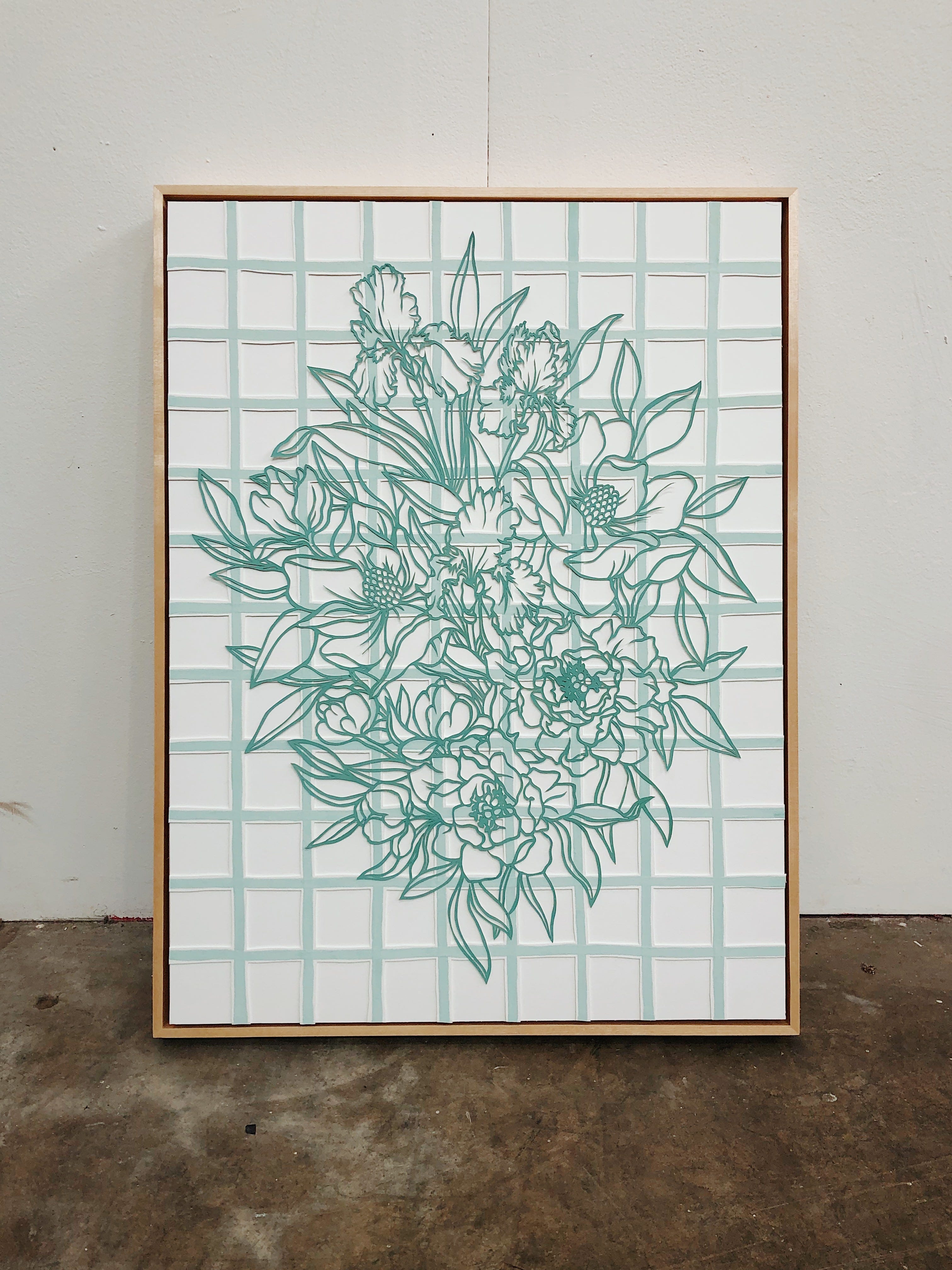
I’ve moved away from cut paper as my primary medium since making this piece a few years ago, but I see now how my early work has influenced how I create compositions for my paintings in this season of my creative career. It may seem silly to think I’ve just stumbled into this realization, but sometimes you can’t see the forest for the trees; it can be incredibly challenging for me to take a step back and be objective about the through lines in my work. I work so often through intuition, not basing my artwork in predetermined meaning but allowing that meaning to show itself to me once I’ve finished the artwork.
I feel lucky to have others’ voices and external views on my work in my life. It’s a privilege to be surrounded by creative voices and folks who push me to dig deeper into my process and the currents carrying my work into the world. I hope to continue connecting the dots between my past work and what I’m creating now, always moving toward meaning.
It’s empowering to have language around our experiences. Abstract thoughts become concrete ideas that can then be communicated effectively through more specific imagery and the written word.
I feel strongly that that is what Substack is offering me — an opportunity to find deeper clarity in my work, tools to grow my creative process into something bigger and more connective, and a space to share with others going through similar thought cycles. Perhaps you’re here reading this with me, realizing you’ve dismissed parts of yourself to make them more palatable. More approachable.
To what end? I am realizing I have anxiety around being truly seen — and therefore judged. What if my work isn’t good enough? Or worse, what if it IS good enough and people end up taking me seriously? What if I can’t meet their expectations? What then?
Gosh this feels like another post brewing here with that line of questioning. All of these thoughts are so dang interconnected; it’s hard to stop writing once I pull a thread and feel something begin to unravel. I think I’ll pause this conversation here for brevity’s sake and quest that way next time I sit down to write.
Thanks reading. Thanks for coming back. Thanks for being.
Aw Haley, yesss. Love reading your reflections on your work and process—it’s so powerful to see how you articulate these connections between structure and spontaneity, control and creativity. Your honesty and depth and playfulness always resonates, and I admire the way you’re allowing yourself to be truly seen in your work. Cheering you on! 🤍
Haley, this totally resonates with me. I'm drafting a post right now and wrote about how, in almost the opposite way, my abstract work is the energy pouring out of me and I'm only now learning that I crave and actually possess the ability to balance it with more meticulous techniques.